
Why Solar Irradiance matters
In any solar energy project, the first step toward an effective system is understanding the solar resource. That resource isn’t just “sunlight” — it’s measured and categorized in three distinct forms:
1. Direct Normal Irradiance (DNI)
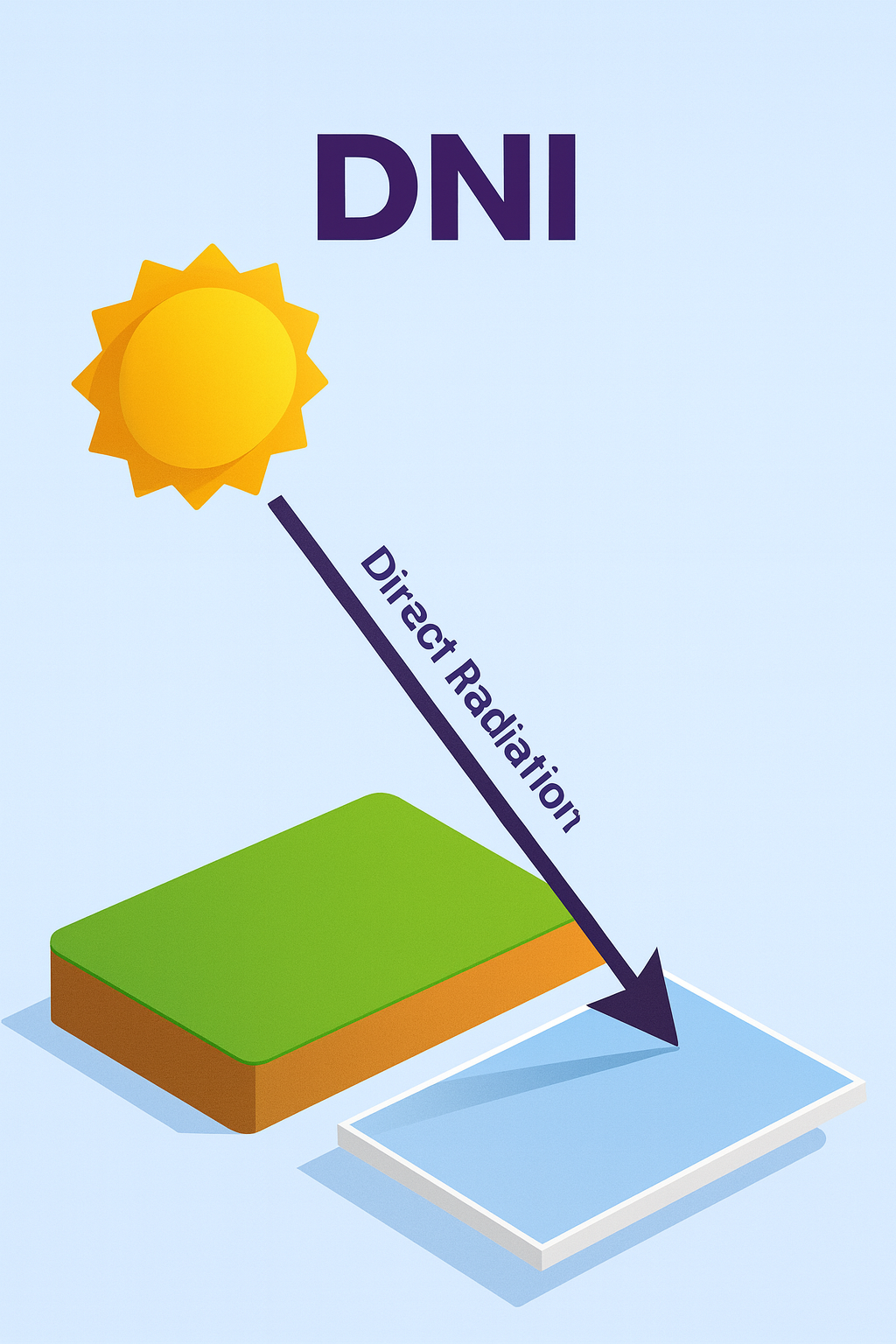
DNI refers to the solar radiation received directly from the sun, measured on a surface that is always perpendicular (or “normal”) to the sun’s rays.
-
Most relevant for concentrated solar technologies (e.g., parabolic troughs, Fresnel lenses).
-
Strongly influenced by cloud cover, aerosols, and solar position.
2. Diffuse Horizontal Irradiance (DHI)
DHI measures sunlight that has been scattered by molecules and particles in the atmosphere. It arrives at the surface from all directions rather than in a straight line.
-
Important for non-tracking systems and for locations with frequent cloud cover.
-
Does not contribute to concentration-based systems but is relevant for flat-panel PV installations.
3. Global Horizontal Irradiance (GHI)
GHI is the total solar radiation received on a horizontal surface, and includes both direct and diffuse components:
GHI = DNI × cos(θ) + DHI
(θ is the solar zenith angle.)
-
Widely used in PV system design and solar resource mapping.
-
Can be measured directly or derived from DNI and DHI.
Why it matters in Industrial Solar Heat projects
Understanding these forms of irradiance is essential when designing solar thermal systems, particularly in industrial settings. Here’s how they relate to Suncom’s areas of focus:
Matching Technology to Resource Type
-
Suncom’s Concentrated Solar Thermal (CST) systems rely primarily on DNI to operate efficiently. These systems concentrate sunlight onto a receiver to produce heat, making them highly sensitive to the quality and consistency of direct solar radiation.
-
In regions with high DNI, CST systems deliver significant thermal output, ideal for industrial process heat.
-
DHI and GHI are less relevant for CST but are important in hybrid systems or in initial site selection studies.
Site Selection and System Performance
-
Accurate DNI measurements help identify suitable locations for solar thermal installations.
-
Understanding seasonal variations in irradiance supports yield forecasting and energy system integration.
-
Knowledge of local DHI and cloud behavior informs risk analysis and storage strategy.
| Phase | Application of DNI/DHI/GHI |
|---|---|
| Feasibility Assessment | Evaluate DNI availability for CST viability |
| System Design | Optimize collector tilt, orientation, and tracking |
| Yield Forecasting | Model annual thermal output based on DNI trends |
| Project Siting | Compare DNI-rich locations for industrial clients |
| Hybrid Integrations | Consider GHI/DHI where PV or electric boilers are used alongside CST |
Conclusion
Understanding the difference between DNI, DHI, and GHI is fundamental in solar energy system design — especially in industrial applications that require large volumes of thermal energy.
Suncom’s solar thermal systems are specifically engineered for environments with high DNI availability, delivering sustainable heat at industrial scale through proven concentrated solar technologies, thermal storage, and integrated control systems.
For more information on how Suncom matches solar resources to heat demand in food, dairy, and manufacturing industries, explore our Solutions & Services or contact our team for a data-driven feasibility assessment.